ZTF News
Home / ZTF News
Astronomers see gravitationally lensed superluminous supernovae for the first time
Dec 12, 2025 | Press Release
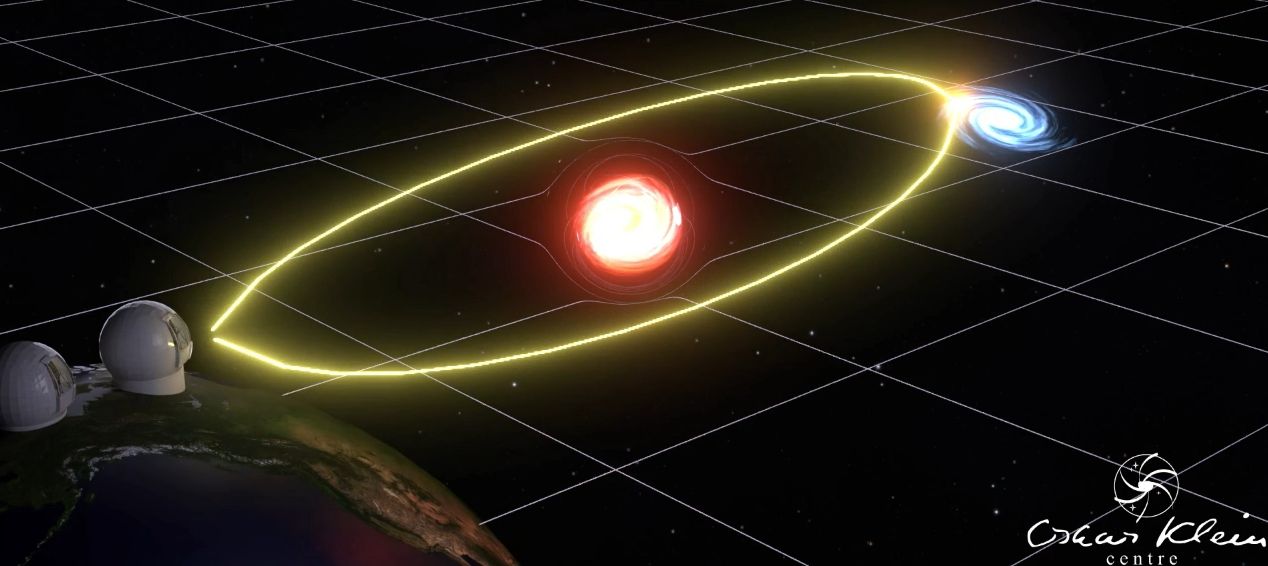
Image caption: An artist’s interpretation of light from a supernova passing through a gravitational lens, reaching Earth at different times. Credit: Oskar Klein Center, Univ of Stockholm / Samuel Avraham & Joel Johansson
In late August this year, the Zwicky Transient Facility was routinely scanning the night sky for transient and variable events. Joel Johansson from the Oskar Klein Center at the University of Stockholm was reviewing the data when an interesting explosion caught his attention. Little did he know at that time that he was seeing the first observations of a gravitationally lensed superluminous supernovae. Several months later, following a series of observations with telescopes across the globe and rigorous analysis, Joel and his colleagues describe this unique discovery in a paper published in the Astrophysical Journal published on Dec 5.
Superluminous supernovae are the big cousins of the more common and well known supernovae shining 10 or more times brighter than them. Despite its immense power, SN2025wny, the event studied by Joel, could be seen from the Eath because it is located at a mind boggling distance from us. Even light, which holds gold medal for speed had to travel 10 billion years to reach us. Detecting this event was only possible because the lights from the supernova encountered galaxies on its way whose gravity bent and magnified the light from the SN2025wny.
“This is nature’s own telescope,” says Joel Johansson, lead author and researcher at the Oskar Klein Centre, Stockholm University. “The magnification of SN2025wny is about 50 times and this lets us study it in detail that would otherwise be impossible.”
The gravitational lensing effect does more than just magnify the supernova – it produces several distinct, spatially separated images of the same explosion. Each lensed image of the supernova takes a slightly different path around the deflecting galaxies, reaching Earth at different times. These time differences offer an independent, highly promising method to measure the Hubble constant, which describes how fast the Universe is expanding.
The multiple images of SN2025wny were first faintly detected with the Liverpool Telescope on La Palma, Canary Islands and later confirmed by Yu-Jin Qin, a Caltech postdoctoral fellow and a member of the ZTF collaboration. Yu-Jing Qin, a postdoctoral researcher at Caltech, led a series of spectroscopic observations using Keck Observatory’s Low Resolution Imaging Spectrometer (LRIS), targeting each of the individual supernova images and the lensing galaxies.
“The spectrum taken with LRIS provides the most convincing measurement of its distance/redshift and pinpointed its classification as a superluminous supernova” said Qin.
The Zwicky Transient Facility has produced the largest supernova survey to date with more than 10000 objects reported. The Its systematic scanning of the dymanic universe has yielded numerous "first-of-its-kind", "odd-ball" and "puzzling" discoveries since it began operations in 2018. The detection of SN2025wny is another one in a series of gravitationally lensed supernova discoveries made by ZTF and its predecessors including the SN Zwicky and iPTF16geu. Spotting lensed supernovae is an event with very low probability. But ZTF and the Vera Rubin Observatory should enable astronomers to gather large enough samples so that they can provide another method to measure the Hubble constant that indicates the rate of expansion of the Universe.
Read the full story in the press release from the University of Stockholm.
More Information
Discovery of SN 2025wny: A Strongly Gravitationally Lensed Superluminous Supernova at z = 2.01 is published in The Astrophysical Journal Letters. DOI: 10.3847/2041-8213/ae1d61
View W.M. Keck Observatory press release.
View the EurikAlert press release.
Media
A short animation of the light from a supernova passing through a galaxy's gravitational lens, split into four, and reaching Earth at different times. Credit: Samuel Avraham & Joel Johansson, OKC
