LIONS Survey
You are here : Home / Survey & Data / Z+LIONS
Z+LIONS Survey
The Z+LIONS survey (ZTF + LSST Inventory of Nuclear Transients and Supernovae) is a magnitude-limited spectroscopic survey of ZTF transients in the Rubin LSST Wide-Fast-Deep (WFD) footprint which commenced on 6 February 2026. Targeting >95% spectroscopic completeness to 20 mag, the ZTF survey covers 10,000 sq. deg of the Rubin Footprint with 1-day cadence and 30 sec exposure in ZTF g,r, and i bands. Transients are identified by filtering ZTF and LSST alert streams; the primary goals are to build a large, well-characterised statistical sample of nuclear transients (SNe, TDEs) for population studies, and to flag unusual events for detailed follow-up. Alert data (including preliminary photometry) are released in real time via the ZTF alert broker Babamul. Spectra and classifications are announced nightly via the Transient Name Server (TNS).
The survey strategy is designed to complement Rubin’s depth: the Rubin WFD programme will cover ~18,000 sq deg in six filters to r ~ 24.7 mag per visit at cadences of a few days, while ZTF provides the daily cadence needed to catch transients at early phases. The LIONS footprint covers ~10,000 sq deg, restricted to −30° < Dec < +30° with the galactic plane excluded (|b| > 7°).
The LIONS survey will use the powerful NGPS - Next-Generation Palomar Spectrograph - mounted in 2024 on the 200-inch Hale telescope at the Palomar Observatory in San Diego.
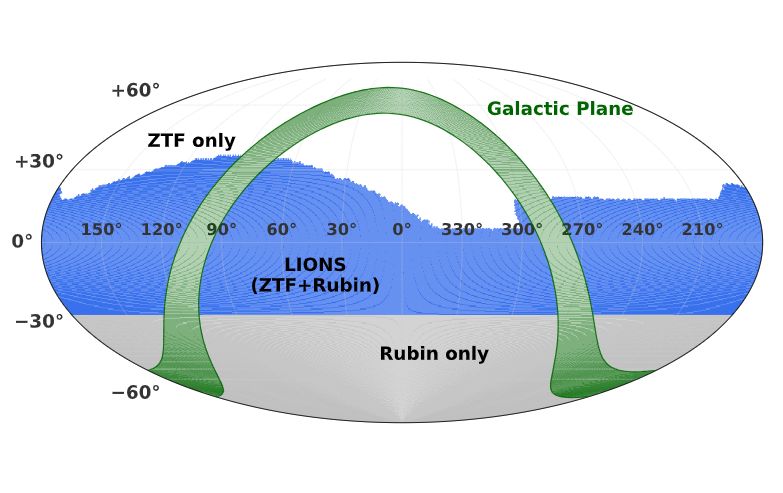
The map shows the full Rubin LSST survey footprint in grey and the LIONS survey region - the overlap between the ZTF accessible sky and the Rubin footprint at Dec > −30° - in blue.
Z+LIONS Survey Leads