Next Generation Palomar Spectrograph (NGPS)
You are here : Home / Survey & Data / NGPS
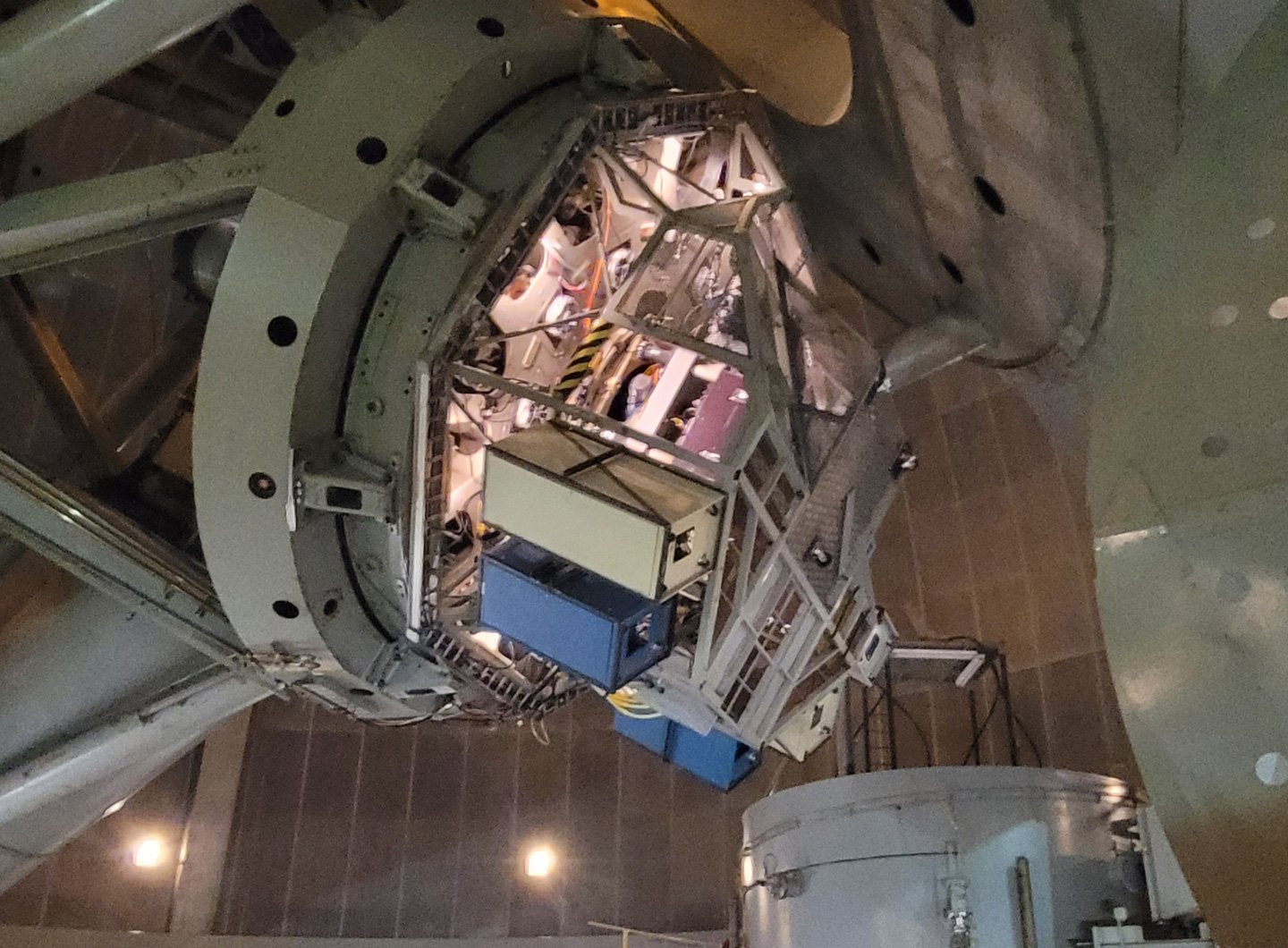
The Next Generation Palomar Spectrograph (NGPS) was installed at the Cassegrain focus on the 200-inch Hale Telescope at Palomar Observatory in late 2024, replacing the Double Spectrograph (DBSP) that operated as the main instrument on Hale for the last 40 years. Its efficient design records up to 70 percent of the light, compared to the 25 percent efficiency of typical spectrographs, making it three times more optically efficient that the DBSP and one of the most efficient single-object spectrographs at the moment. The NGPS is designed for rapid, detailed spectroscopic analysis of transient objects, including supernovae, tidal disruption events, and near-Earth objects. The NGPS is the workhouse for the LIONS survey.
Key Specifications of NGPS:
- Optical wavelength coverage: 365 nm to 1050 nm without gaps
- Resolving power: R=4500 (at a typical configuration of 0.5 arcsec slice width)
- Technology: The NGPS uses an adjustable slit-slicer for minimal losses and VPH gratings for higher light efficiency. It has an acquisition-and-guide camera with a 4.4 arcmin field of view allowing instant, automated recognition of the field for an arbitrary pointing anywhere on the sky.Targets can be centered on the slit without human intervention, enabling a minimal acquisition time of just 7.5 seconds after slewing to the field.
The NGPS is designed to work with future adaptive optics systems, such as the SIGHT instrument.
The instrument is a collaboration between partners in the US and China. On the US side, the partners are Caltech; the Jet Propulsion Laboratory, the National Science Foundation; and the Heising–Simons Foundation. The China partners are the Kavli Institute for Astronomy and Astrophysics at Peking University and the National Astronomical Observatories of China (NAOC).
Planning & Observing Manual OTM & ETC Manual
Report an issue